Connect a Postman API key to check your work
You do each step in Postman, then LiftOff uses your key to look at your workspace and confirm it's done. Connect once and it works for every module. Your key is saved in this browser and is only used to check your work in Postman.
In this project, you are responsible for a support agent used by a fictional fintech company. Customers contact the support team when they do not recognize a transaction, need an investigation update, or want to understand what happens next. Answering those questions safely requires information from several systems—not just a model response.
The agent brings those systems together. It can read banking transactions, inspect support cases and evidence, request a fraud-risk assessment, take approved support actions, and draft a customer-safe response. The Banking and Support capabilities are exposed as MCP tools, while fraud assessment remains a REST API. An AI model decides which capabilities are needed for each request.
The supplied application runs this same support agent in two modes. Direct mode connects the application separately to the model, both MCP servers, and the Fraud API. Fabric mode sends that traffic through routes you configure on Fabric Gateway. Because the prompt, agent logic, and backend data remain the same, you can compare what changes when routing, credentials, tool discovery, policies, and observability move into the gateway.
You are not writing the agent or deploying the fintech services in this module. You are turning the supplied components into a governed agent system: first by understanding and testing the finished project, then by creating your own Fabric routes and connecting the local agent to them.
For additional background on why agent execution benefits from a governed gateway, you can read Agent Gateway: The Next Evolution of the API Gateway.
Understand the Project Architecture
The fictional bank separates business responsibilities across three services. Two services have MCP servers that translate their APIs into model-safe tools. Fraud remains REST-only so the project demonstrates that Fabric can govern models, MCP servers, and ordinary APIs together.
| Component | What it does |
|---|---|
| Support AI Agent | Reads the case, resolves the customer and transaction, requests a fraud assessment, takes permitted actions, records an audit note, and drafts a customer response. |
| AI Model | Reasons over the prompt and tool results, selects tools, and produces the response. |
| Banking API | Owns customers, accounts, cards, transactions, transfers, and disputes. |
| Banking MCP | Exposes Banking API operations as model-safe tools while keeping API authentication outside model-visible arguments. |
| Support API | Owns cases, notes, evidence, verification requests, escalation, and investigation status. |
| Support MCP | Exposes Support API operations as model-safe tools and injects authentication and request metadata. |
| Fraud REST API | Evaluates transaction risk and recommends an action. It intentionally has no MCP server. |
| Fabric Gateway | Routes model, MCP, and REST traffic; brokers credentials; applies plugins and policies; and records evidence. |
| Support agent application | Provides the learning interface, runs the same fintech support workflow through Direct and Fabric lanes, and displays responses, tools, timing, tokens, failures, and assertions side by side. |
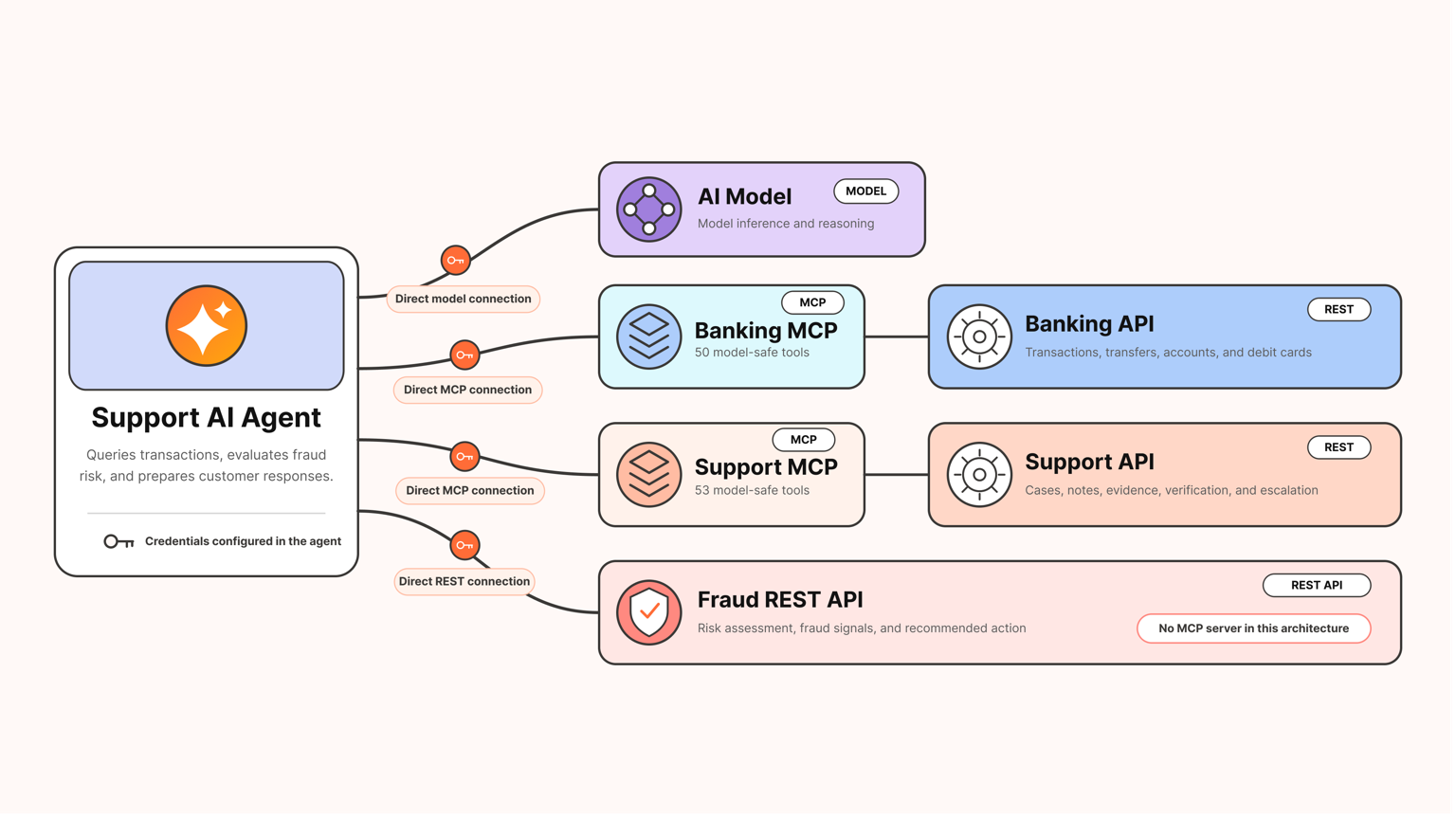
Direct architecture
The Direct lane maintains separate URLs and credentials for the model, Banking MCP, Support MCP, and Fraud API. Service failures can cross the agent boundary and consume another model turn.
Fabric architecture
The Fabric lane connects to governed Fabric routes. Fabric holds upstream bindings, exposes both MCP services through one route, applies policy, and provides one place to observe the complete request path.
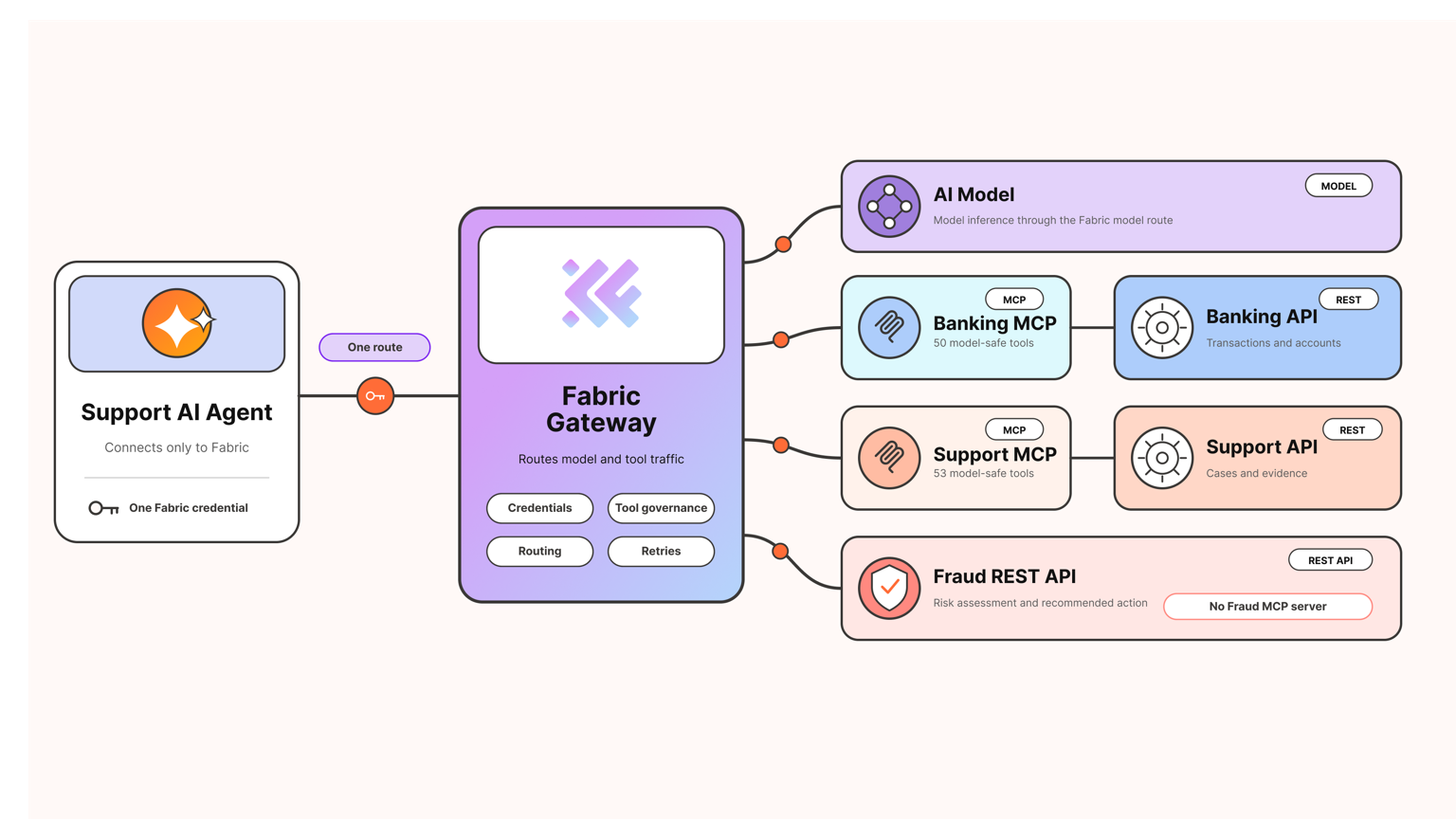
Expected outcome: You can explain which system owns each piece of banking data, what each MCP server contributes, and what moves from the application into Fabric Gateway.
Compare the Hosted Direct and Fabric Experiences
-
Copy the hosted fintech support agent URL:
https://fabric-banking-demo-production.up.railway.app/Open the copied URL in a new browser tab.
-
Choose one prompt:
Goal Prompt Inspect a transaction What can you tell me about TX-1042?Review a support case Summarize CASE-2042 and recommend the next safe action. Do not make any changes.Compare records Compare TX-1042 with CASE-2042 and explain the current investigation status. Do not make any changes.Run the complete workflow Investigate the customer report in CASE-2042 about TX-1042, assess its fraud risk, take the safe next steps, and draft a customer response. -
Leave Return 429 on the first fraud assessment enabled.
-
Select Run comparison.
-
Read both customer-facing responses. Did both lanes identify the same case, transaction, risk, and safe action?
-
Compare the tools available and called, model turns, token usage, elapsed time, failures shown to the model, credential footprint, and final assertions.
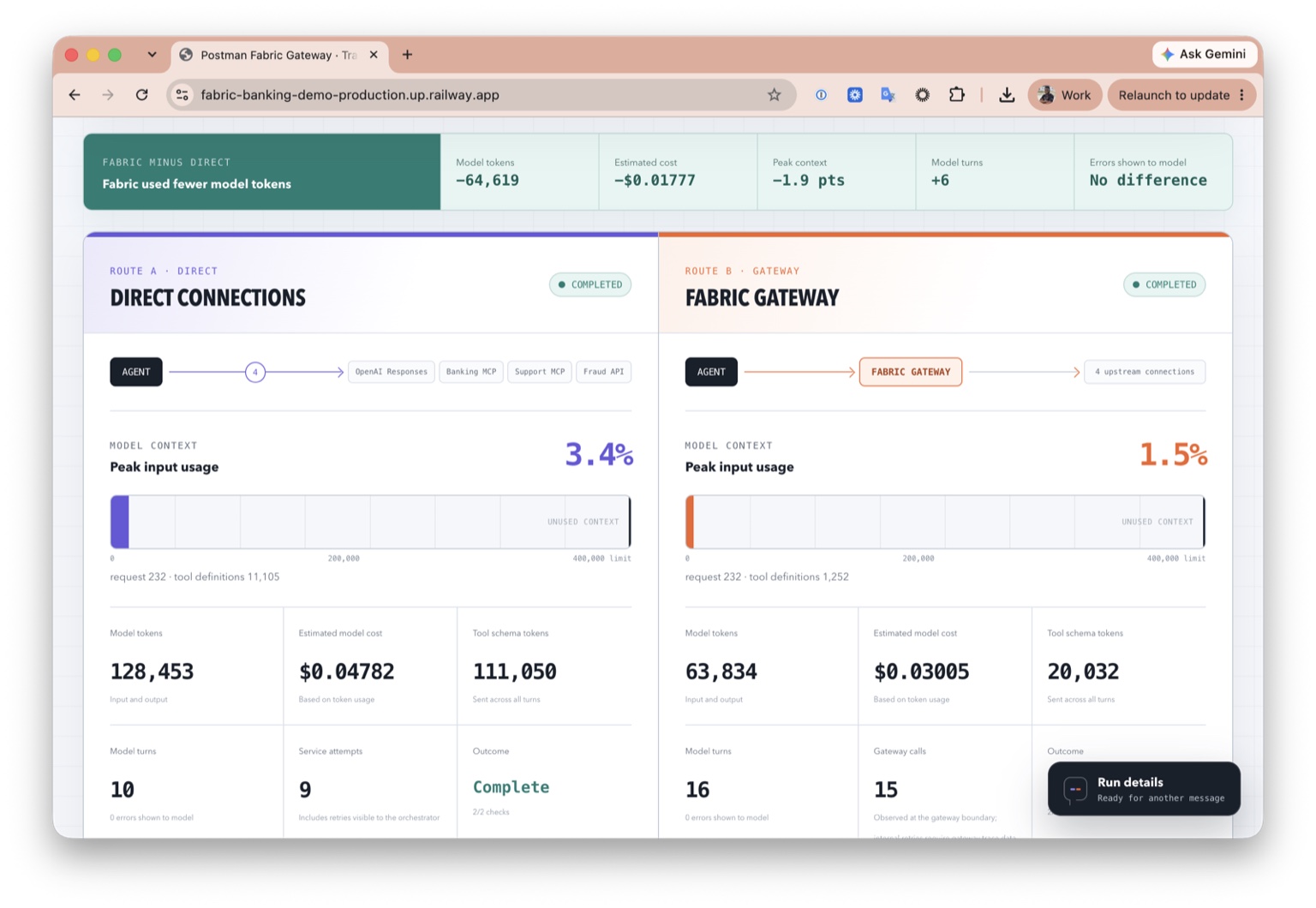
What to notice
The exact totals can vary between runs, but the example above shows the operational cost of exposing the full Direct tool catalogue instead of using Fabric's smaller discovery surface:
| Measurement | Direct | Fabric | Difference |
|---|---|---|---|
| Tools initially exposed | 104 | 4 | Direct exposes 26× as many tools |
| Model tokens | 128,453 | 63,834 | Direct uses just over 2× as many tokens |
| Peak context usage | 3.4% | 1.5% | Direct uses about 2.3× as much context |
| Estimated model cost | $0.04782 | $0.03005 | Direct costs about 1.6× as much to run |
| Tool-schema tokens | 111,050 | 20,032 | Direct sends about 5.5× as many tool-schema tokens |
Look for the same measurements in your run. The important comparison is not only whether both routes complete the task, but how much model context and cost each route needs to reach the result.
Expected outcome: Both lanes solve the same task. The meaningful difference is how traffic is routed, governed, retried, authenticated, and observed.
If you are stuck: Refresh the application and run the comparison again. If a lane remains unavailable, use Sample mode to review the completed comparison interface; Sample mode does not execute the live agent.